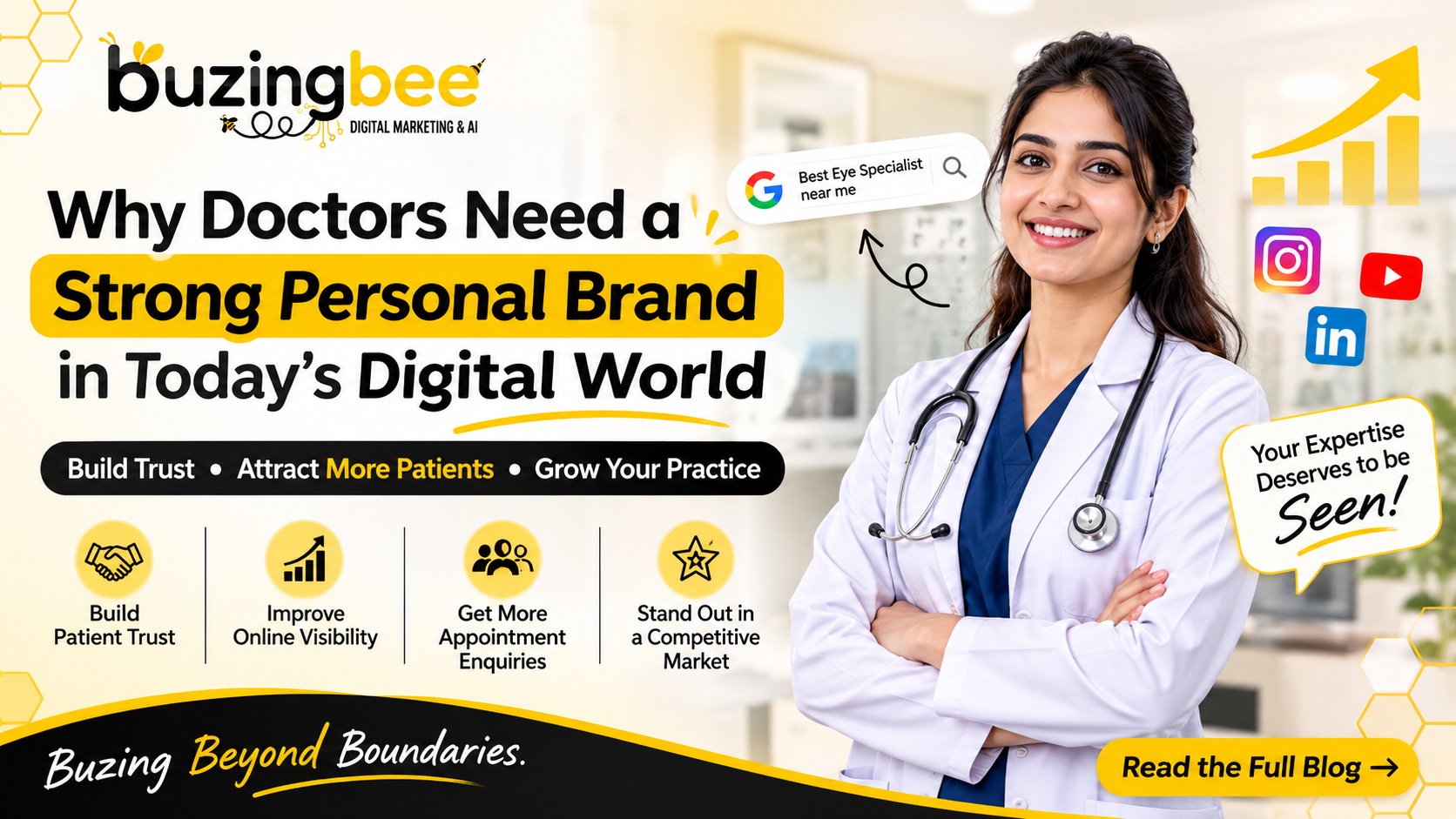
Why Doctors Need a Strong Personal Brand in Today's Digital World
In today's digital world, patients don't just look for a doctor nearby. They also search online to understand a doctor's experience, expertise, communication style and reputation before deciding whom to consult.
This is why building a strong personal brand has become increasingly important for doctors, specialists, clinics and healthcare professionals.
Think about the way people make decisions today. Before visiting a restaurant, they check its Google reviews. Before purchasing a product, they compare different brands. Similarly, before booking a medical appointment, many patients search for the doctor's name on Google, visit their Instagram profile, watch educational videos or check the clinic's online presence.
This change in patient behaviour creates an important opportunity for doctors.
A doctor who consistently shares useful medical information, communicates clearly and maintains a professional online presence can build familiarity and trust with potential patients.
However, personal branding is not simply about uploading photographs, posting daily reels or collecting followers. It is about communicating your expertise in a way that helps people understand who you are, what you do and why they may consider consulting you.
At BuzingBee, we believe that every doctor has valuable knowledge and experience. The challenge is to turn that expertise into a strong digital identity.
Let's understand why doctors need a strong personal brand and how a strategic digital marketing approach can help them build one.
1. Patients Are Searching for Doctors Online
The way patients discover healthcare professionals has changed significantly.
Earlier, people mostly depended on family recommendations, local references and word-of-mouth publicity. These sources are still important, but digital platforms have added another layer to the decision-making process.
Today, someone looking for an eye specialist might search:
- Best eye specialist near me
- Experienced eye doctor in Dhanbad
- Best ophthalmologist for cataract treatment
- Eye specialist for children near me
- How to choose the right eye doctor
These are examples of long-tail searches that show what potential patients want to know.
A doctor's digital presence can help answer these questions even before a patient makes a phone call.
For example, an ophthalmologist who regularly shares educational content about eye health, common vision problems, preventive care and treatment options can become more familiar to people searching for eye-related information.
This is one reason why personal branding for doctors through digital marketing is becoming an important part of healthcare marketing.
The goal is not to replace medical referrals or professional reputation. It is to make a doctor's expertise easier to discover and understand online.
2. A Personal Brand Helps Build Patient Trust
Healthcare is a trust-driven industry.
Patients are not simply purchasing a product. They are making decisions related to their health, comfort and well-being. Naturally, they want to feel confident about the professional they choose.
A strong personal brand helps doctors communicate their knowledge, values and approach to patient care.
Consider two doctors with similar qualifications and experience.
The first doctor has very little information available online. The second doctor has a professional website, an updated Google Business Profile and educational videos explaining common health concerns.
Both may be equally qualified, but the second doctor has made it easier for potential patients to understand their professional identity.
This does not automatically make the second doctor a better medical professional. It simply makes their expertise more visible.
Doctors can build trust through:
- Educational videos explaining common health conditions.
- Clear introductions about their qualifications and specialisation.
- Patient-friendly explanations of medical procedures.
- Answers to frequently asked health questions.
- Professional photographs and clinic information.
- Consistent and accurate communication across digital platforms.
The key is to educate rather than exaggerate.
A doctor should never promise guaranteed results, encourage unnecessary treatment or use misleading claims just to attract attention.
A strong medical personal brand is built on credibility, not exaggerated marketing.
3. Social Media Gives Doctors an Opportunity to Educate People
Social media has become an important communication channel for healthcare professionals.
Platforms such as Instagram, Facebook and YouTube allow doctors to explain medical topics in simple language and reach people beyond their immediate professional network.
However, many doctors make one common mistake: they treat social media as a platform for posting random photographs and festival greetings.
A better approach is to build a structured content strategy.
For example, an eye specialist can create content around:
- Early signs of common eye problems.
- Why regular eye check-ups matter.
- Common myths about spectacles.
- Digital screen habits and eye health.
- Children's eye health and vision development.
- When someone should consult an ophthalmologist.
- Frequently asked questions about eye procedures.
These topics answer real questions that people may already have.
A short educational reel explaining why someone should not ignore sudden changes in vision may provide more value than a generic promotional post.
Similarly, a carousel explaining common eye-care mistakes can encourage people to save and share the information.
The objective of social media marketing for doctors and healthcare professionals should be to make medical knowledge easier to understand.
A good content strategy generally includes three categories:
Educational content: Helps people understand health conditions, symptoms, prevention and treatment options.
Personal branding content: Introduces the doctor's professional journey, specialisation, experience and approach to patient care.
Engagement content: Uses questions, common misconceptions and relatable situations to encourage meaningful interaction.
The balance between these categories helps create a recognisable and informative online identity.
4. Short-Form Videos Help Doctors Communicate Their Expertise
Short-form videos have changed how people consume information online.
Instagram Reels, YouTube Shorts and Facebook videos give doctors an opportunity to explain complex topics in a simple and engaging format.
For many healthcare professionals, appearing on camera may initially feel uncomfortable. They may not know what to say, how to present information or how to make medical topics interesting.
This is where professional content planning and video production become useful.
For example, instead of creating a video with the title "Eye Care Tips", a more specific topic could be:
"Can using your phone in the dark damage your eyes?"
The doctor can explain the topic, clarify common misconceptions and share appropriate advice.
Other examples include:
- "Why do your eyes feel tired after working on a laptop?"
- "Are children using spectacles at an early age?"
- "Can you identify cataract symptoms early?"
- "What happens during a routine eye examination?"
- "When should you visit an eye specialist?"
A well-produced educational video usually requires more than a camera.
It needs:
- Topic research based on patient questions.
- A clear and medically accurate script.
- Proper shoot planning.
- Professional recording and lighting.
- Editing with readable captions and relevant visuals.
- An informative caption and suitable publishing strategy.
This process helps doctors focus on explaining their expertise while the marketing team manages content production.
The aim is not to make every doctor an entertainer. It is to help them communicate confidently and professionally.
5. Google Visibility Helps Patients Discover Your Practice
Social media is important, but doctors should not depend on Instagram alone.
Imagine a patient searching on Google for an experienced dermatologist in their city. They may see local clinic listings, Google Maps results, websites, reviews and other relevant information.
If a doctor has an incomplete Google Business Profile or a poorly maintained website, potential patients may struggle to find accurate information.
This is why local SEO for doctors and clinics deserves attention.
A strong local search presence may include:
Google Business Profile optimisation: Ensure the clinic's name, address, contact details, working hours, services and website information are accurate.
Website optimisation: Create useful pages explaining the doctor's specialisation, qualifications, clinic location and relevant services.
Local SEO: Improve the website's relevance for location-based searches such as "dermatologist in Dhanbad" or "eye specialist in Kolkata".
Patient-friendly content: Publish informative articles that answer common questions related to the doctor's speciality.
Review management: Encourage genuine patient feedback in an ethical manner and respond professionally without revealing private medical information.
These activities can improve the quality of a doctor's online presence and help potential patients find useful information.
It is important to understand that SEO does not guarantee first-page rankings or a fixed number of appointments. Search visibility depends on competition, relevance, website quality, location and several other factors.
6. A Professional Website Makes Your Digital Identity Stronger
A social media profile is useful, but it does not provide complete control over how a doctor presents their professional identity.
A dedicated website creates a central place where patients can find verified information.
A well-designed doctor's website may include:
- Doctor's introduction and professional biography.
- Educational qualifications and specialisation.
- Clinic address and contact details.
- Consultation information.
- Services and treatment information.
- Appointment enquiry options.
- Frequently asked questions.
- Educational blogs and health resources.
For example, a patient searching for a cardiologist should be able to understand the doctor's speciality, clinic location and consultation process without having to search through multiple social media posts.
A website also supports long-term SEO efforts.
Useful articles such as "Common Signs That You Should Consult a Cardiologist" or "Why Regular Heart Check-ups Matter" can help answer patient questions and build topical relevance.
However, all medical content should be reviewed by the doctor before publication.
The website should also be mobile-friendly, easy to navigate and clear about how patients can contact the clinic.
7. Consistency Matters More Than Random Posting
Many doctors start their social media journey with enthusiasm.
They post regularly for a few weeks, upload some reels and then stop because of their busy clinical schedules.
This creates a common problem: inconsistent communication.
Doctors already have demanding responsibilities. Managing consultations, patient care and administrative work leaves limited time for content planning, recording and publishing.
That is why a structured monthly content calendar can make a difference.
For example, a healthcare content calendar might include:
Content typeMonthly planning example
Educational reels
8
Informative carousels
4
Professional posts
4
Stories
12
Health awareness content
As relevant
These are illustrative planning quantities, not a universal formula. The right frequency depends on the doctor's availability, audience and content quality.
A consistent approach helps maintain communication without overwhelming the doctor.
The focus should remain on useful information rather than posting simply to fill a calendar.
8. Paid Advertising Can Support Patient Acquisition
Organic content and SEO help build long-term visibility, but some clinics may also need targeted advertising to promote relevant services.
Platforms such as Google Ads and Meta Ads provide different ways to reach potential audiences.
For example:
Google Ads: A clinic may use relevant search campaigns to reach people actively looking for a particular healthcare service in a specific location.
Meta Ads: A clinic may promote educational videos, awareness campaigns or suitable service information to relevant audiences.
However, healthcare advertising requires additional care.
Campaigns should follow applicable advertising laws, platform policies and professional medical ethics. They should avoid misleading claims, fear-based messaging, guaranteed treatment outcomes and inappropriate use of patient information.
Advertising should also lead to a useful destination, such as a relevant service page or a clear appointment enquiry process.
Simply generating a large number of clicks does not mean a campaign is successful.
A better approach is to evaluate relevant enquiries, enquiry quality, appointment processes and campaign costs.
9. How BuzingBee Helps Doctors Build a Strong Personal Brand
At BuzingBee, we approach healthcare marketing as a combination of strategy, content, visibility and performance.
We don't believe that a doctor's digital growth should depend only on random social media posts.
Every doctor has a different specialisation, target audience, location, professional personality and communication style. Therefore, the marketing strategy should be developed around those factors.
Here is how we approach the process.
Step 1: Understanding the Doctor and Their Goals
Before creating content, we understand the doctor's professional background, specialisation, services and target audience.
We also discuss what the doctor wants to achieve through digital marketing.
For example:
- Build awareness for a new clinic.
- Improve personal brand visibility.
- Educate people about a particular speciality.
- Improve local search presence.
- Generate relevant appointment enquiries.
- Establish a consistent social media identity.
This initial research helps us avoid generic marketing.
Step 2: Developing a Personal Branding Strategy
After understanding the doctor, we create a communication strategy.
We identify the main content pillars, audience interests, relevant topics and suitable platforms.
For an ophthalmologist, the strategy may focus on eye health education, common vision problems, preventive care and frequently asked patient questions.
For a dermatologist, the content pillars may include skin health, common skin conditions, skincare misconceptions and treatment education.
The objective is to create a distinct digital identity that reflects the doctor's real expertise.
Step 3: Content Research and Script Development
Our team researches relevant topics and develops content ideas that can be explained in a simple and engaging way.
We plan hooks, scripts and visual approaches while ensuring that medical claims are reviewed and approved by the doctor.
This is important because healthcare content must be accurate.
A catchy headline is not useful if it creates unnecessary fear or spreads incorrect medical information.
Step 4: Professional Shoot and Video Production
Once the scripts are approved, we plan the recording process.
This may include:
- Shoot scheduling and preparation.
- Camera framing and lighting.
- Audio and recording setup.
- Guidance for presenting on camera.
- Video editing and subtitles.
- Relevant graphics and visual elements.
We aim to make the doctor comfortable while helping them communicate naturally.
Step 5: Social Media Management
After production, we organise the content for publishing.
This includes content scheduling, captions, creative design, platform-specific formatting and regular content management.
We also monitor audience interaction and identify topics that may deserve further attention.
The objective is to maintain a professional and consistent online presence.
Step 6: Website, SEO and Google Business Profile
A complete healthcare digital marketing strategy should not depend on social media alone.
Depending on the doctor's requirements, we also work on website development, SEO, local SEO and Google Business Profile optimisation.
This helps connect social media visibility with search discovery.
Step 7: Performance Tracking and Strategy Improvement
Digital marketing should be measured rather than judged by appearance.
We review relevant metrics such as:
- Reach and audience engagement.
- Video views and watch time.
- Profile visits.
- Website traffic.
- Search visibility.
- Relevant appointment enquiries.
- Campaign performance and cost.
Based on these observations, we identify what is working and where the strategy needs improvement.
We do not promise a fixed number of followers, patients or appointments. Our focus is on building a measurable and sustainable marketing process.
10. Why Doctors Should Start Building Their Personal Brand Today
Personal branding is not something doctors should consider only after opening a large hospital or establishing a multi-location clinic.
Even an independent medical practitioner can benefit from a professional digital presence.
Starting early gives doctors more time to communicate their expertise, publish useful educational content and build familiarity with their audience.
A strong personal brand can support:
- Better professional visibility.
- Easier discovery through digital platforms.
- Improved communication with potential patients.
- Greater awareness of specialisation and services.
- A stronger foundation for long-term reputation building.
- More organised digital communication.
But remember: followers are not the same as patients, views are not the same as trust, and online popularity is not proof of medical expertise.
The real objective is to make accurate professional information accessible to the people who may need it.
Conclusion: Your Medical Expertise Deserves the Right Digital Identity
Doctors spend years developing their knowledge, improving their skills and caring for patients. But if people cannot easily discover their expertise online, an important opportunity to communicate that value may be missed.
In today's digital environment, building a strong personal brand is no longer just about looking professional on social media. It is about creating a consistent and trustworthy identity across search engines, websites and social platforms.
From educational reels and content strategy to website development, local SEO and paid advertising, every activity should work towards a clear purpose.
At BuzingBee, we help doctors and healthcare professionals turn their expertise into a structured digital presence through strategic content creation, social media management, SEO, website solutions and digital marketing.
We believe that healthcare marketing should be built on trust, education and consistency.
Your expertise builds your reputation. The right digital strategy helps more people discover it.
Want to Build Your Medical Personal Brand?
If you are a doctor, specialist or healthcare professional looking to strengthen your online presence, BuzingBee can help you plan and manage your digital growth strategy.
Visit www.buzingbee.com to explore our digital marketing solutions.
Frequently Asked Questions (FAQs)
1. Why is personal branding important for doctors?
Personal branding helps doctors communicate their qualifications, specialisation, professional approach and medical knowledge. It can improve online visibility and help potential patients understand a doctor's expertise before making an appointment.
2. How can doctors build a personal brand on Instagram?
Doctors can build an Instagram presence by sharing educational reels, answering common health questions, introducing their specialisation, publishing informative carousels and maintaining a consistent professional identity. Medical information should always be accurate and reviewed by the doctor.
3. Which social media platform is best for doctors?
Instagram, Facebook, YouTube and LinkedIn can all be useful, depending on the doctor's audience and objectives. Instagram is suitable for short educational videos, YouTube supports detailed explanations, Facebook can support local community communication, and LinkedIn is useful for professional networking.
4. How does digital marketing help doctors get more patients?
Digital marketing can improve a doctor's visibility through search engines, social media, websites and advertising. It can help potential patients discover relevant services and make appointment enquiries. Actual patient acquisition depends on factors such as location, reputation, service quality, competition and enquiry handling.
5. What services does a healthcare digital marketing agency provide?
A healthcare digital marketing agency may provide personal branding, social media management, content creation, video production, website development, SEO, Google Business Profile optimisation, paid advertising and performance reporting.
6. How often should doctors post on social media?
There is no fixed posting frequency for every doctor. A consistent and realistic content calendar is more useful than posting every day without a strategy. The frequency should depend on the doctor's availability, audience and content quality.
7. Can a doctor build a personal brand without showing their face?
Yes. Doctors can start with voice-over videos, educational carousels, presentations and informative graphics. However, appearing on camera can help audiences become more familiar with the doctor when done professionally and comfortably.
8. How can BuzingBee help doctors with digital marketing?
BuzingBee helps doctors develop a structured digital presence through personal branding strategy, content research, reel production, social media management, website development, SEO, Google Business Profile optimisation and digital advertising.